
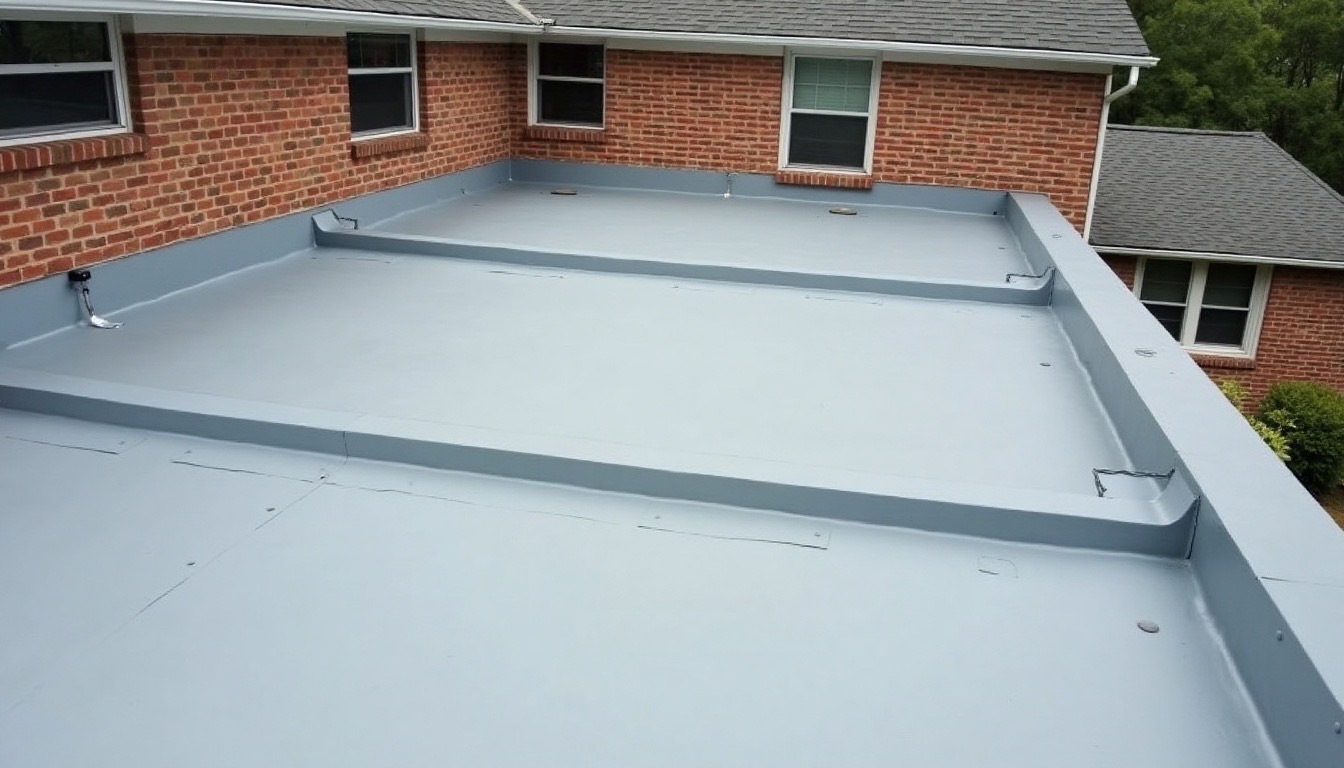
Flat Roof Repair
The roof above a porch, addition, or other low-slope section can raise different questions from the main roof. If that is the area troubling you, identify it in your flat roof repair request for Macon. Explain what you noticed and where, even if you are unsure whether the surface is a membrane, another covering, or part of a mixed roof arrangement.
Do not select a repair product from the appearance of the ceiling below. Start with the problem history and ask how the existing covering will be identified. If a previous repair or coating is documented, mention it. If the age or material is unknown, leave it unknown. The assessment should establish the relevant condition and support a proposed scope that can be explained before you decide what work to authorize.
Make drainage a specific assessment question
If you have already observed water remaining on the roof from a safe location, describe where and when you saw it. Do not go onto the surface to measure or investigate it. Ask whether drainage arrangements need to be examined as part of the assessment and what findings would affect the proposed repair. This keeps a useful question in view without assuming that drainage is the cause of every problem.
Include any change you know about near an outlet or roof edge, while distinguishing your observation from a diagnosis. A message might say that you noticed water in a different place than before or that the concern is near an addition. The important detail is the change you can describe, followed by the question you need answered. A recommended repair should make clear whether it addresses that concern and whether anything about drainage remains outside the proposed work.
Ask about seams, edges and transitions
Ask which joints, roof edges, penetrations, or transitions are relevant to the reported issue. If the low-slope section meets a wall or another roof, identify that feature in ordinary language. You do not need to know the name of the detail to ask how it will be checked. Request an explanation that shows why a particular area is included in the recommendation.
The existing roof material should be identified before a repair material is agreed. Ask what supports the choice and whether any earlier patch affects the plan. If a proposal describes work across a whole section, ask why that extent is needed. If it describes a localized repair, ask where its boundaries fall. Those questions help make two proposals comparable without assuming either a small patch or a broad treatment is automatically the better answer.
Keep moisture questions separate from assumptions
When a room below the roof is affected, describe the exact location, the first date you noticed the issue, and any later change. Ask what can be established about the roof assembly during the assessment and what would need further investigation. If the proposal refers to hidden conditions, request clarity about what has been observed and what is still only a possibility.
The roofing request should not have to settle those questions in advance. A useful assessment can explain its limits as well as its findings. Ask how any newly discovered condition would be discussed before the work changes. If you are uncertain which service fits the concern, the guide to choosing an assessment can help you describe it. Keep the low-slope section's location in the message so it is not lost within a general report that the house has a leak.
Decide how far the repair should go
Review the proposed area of work, the material specification, and the explanation for that extent together. Ask what the repair is intended to correct and what it does not address. If a larger project is suggested, ask why a limited repair would be unsuitable for the findings. If a repair is suggested, ask how it fits with any condition elsewhere on the same roof section that has been discussed.
For a free quote, use the size and extent of the proposed work as the starting frame. Clarify access, preparation, replacement materials, and disposal where relevant. Check whether the proposal covers only the roof or includes any other property work. A ceiling finish, for instance, should be raised as a separate scope question instead of silently assumed to be included. Ask how changes will be handled before authorizing work beyond the initial agreement.
Plan care around the actual roof
After the assessment, ask what observations would justify getting back in touch and whether the identified product has specific care requirements. Request guidance for that roof rather than following a generic maintenance schedule found elsewhere. Keep the scope and any material information with your property records so a future discussion can start from what was actually done and where. For a Macon-area property, you can describe the low-slope area for a quote using your name, phone, optional address, and message. Include whether the concern involves a porch, addition, or another part of the building, plus any known history of the problem. There is no need to provide measurements you cannot obtain safely. Appointments confirmed after your request is reviewed. Begin with a clear description, then use the assessment to settle the material, extent, and next steps for your own roof. For future reference, keep a simple sketch in your own notes identifying the section discussed, such as the rear addition or the porch beside an entrance. It does not need dimensions. Add the date and the description from the agreed scope so a later conversation can distinguish this work from another roof area. Ask for any care guidance to refer to the material actually identified rather than an assumed product.